

Figuring out what to include in wedding invitation details sounds easy until you are staring at a blank design wondering where the dress code goes, whether you need the full venue address, and how much information is officially too much. The good news? Your invite does not need to explain the entire weekend. It needs to give guests the essential information clearly, while the details card or website handles everything else.
Before You Send It To Print
A quick invitation checklist can save you from a very expensive reprint.
- Make it immediately clear who is getting married.
- Include the correct date, ceremony time, and location.
- Decide whether you need a host line and how formal it should sound.
- Tell guests what happens after the ceremony.
- Give them a clear way to RSVP and a deadline.
- Move travel, accommodations, parking, registry details, and longer instructions somewhere else.
The goal is not to squeeze every possible detail onto one beautiful piece of stationery. It is to make the important information easy to read.
What Belongs On The Main Card?
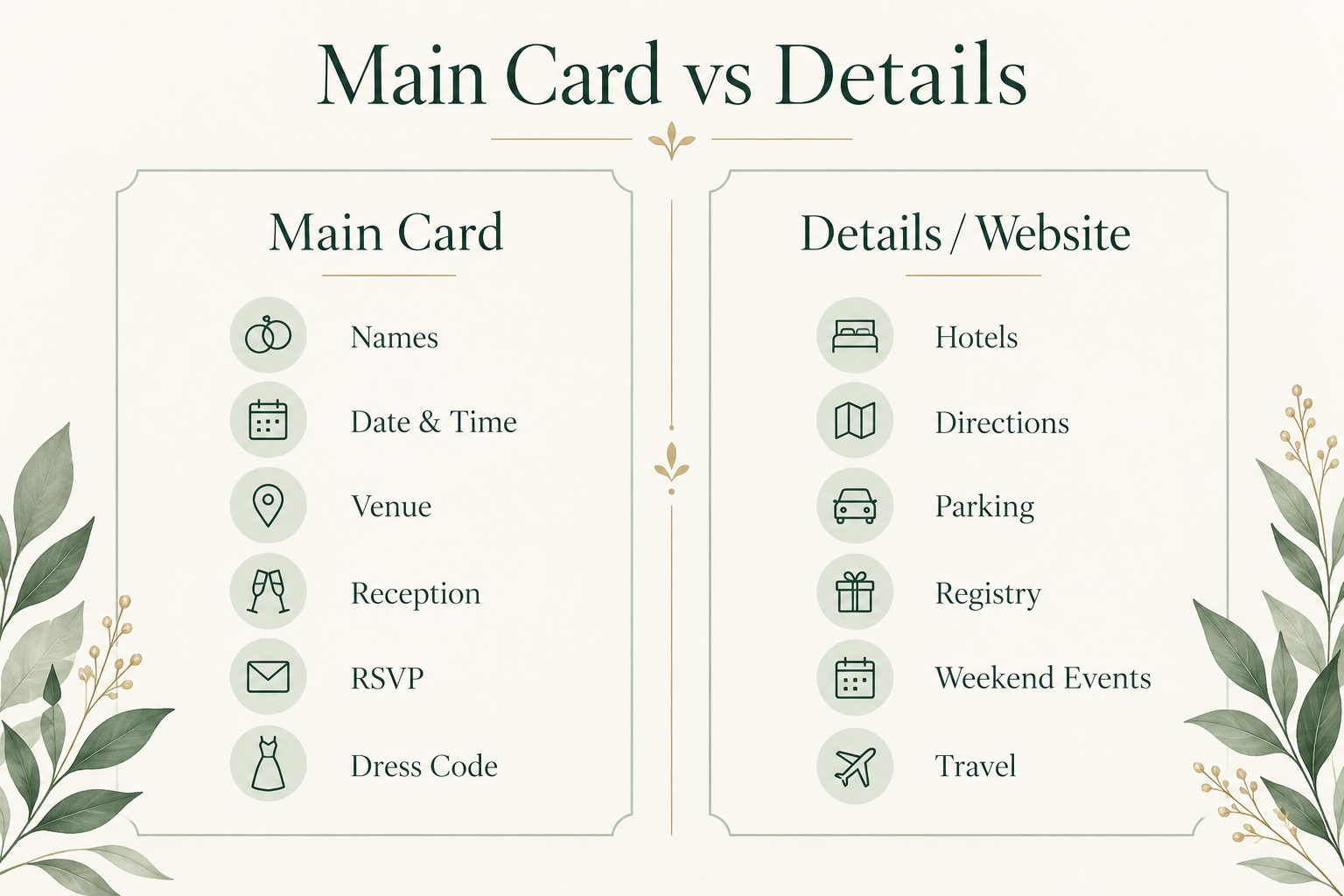
Think of the main card as the information a guest would need if their phone disappeared on the way to the celebration.
| Include | Usually Put Elsewhere |
|---|---|
| Couple’s names | Hotel recommendations |
| Date and ceremony time | Detailed directions |
| Ceremony venue | Parking instructions |
| Reception line | Registry information |
| Basic RSVP direction | Full weekend schedule |
| Dress code, when useful | Transportation details |
That distinction matters. One of the easiest ways to make a beautiful design difficult to use is asking the main invitation to do the job of your entire wedding website.
Start With The Host Line
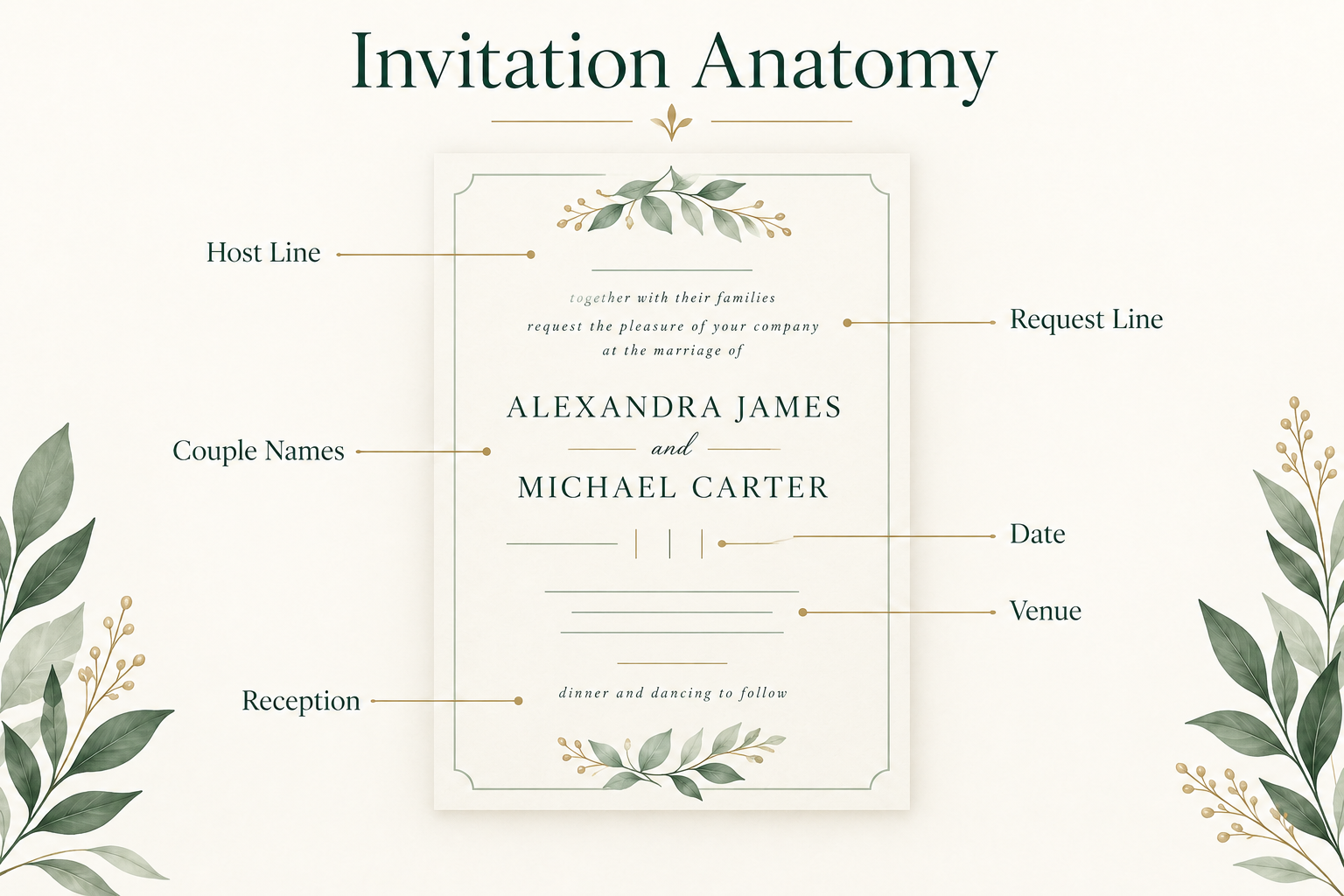
The host line traditionally identifies who is inviting guests to the celebration. That might be one set of parents, both families, the couple themselves, or a combination.
Modern celebrations give you plenty of flexibility here. If both families are contributing, something simple such as “Together with their families” can keep the wording warm without turning the top of the invite into a family tree.
For a more traditional approach, the Emily Post formal invitation wording guide explains established etiquette for hosts, titles, ceremony locations, dates, and times.
Choose A Request Line That Sounds Like You
Next comes the request line, or the actual invitation to attend.
A formal invitation might use traditional language, while a relaxed celebration can simply say that the couple would love guests to join them. There is no prize for making this sentence sound fancier than the event itself.
Then add the couple’s names clearly. This is not the place for cleverness that makes Aunt Susan wonder whose ceremony she has actually been invited to.
Your invitation wording should sound consistent from top to bottom. If the design and celebration are modern and casual, suddenly switching into ultra-traditional phrasing can feel disconnected.
Quick Tip
Read the entire invitation aloud before approving the proof. Awkward phrasing, repeated words, and missing information become much easier to notice when you hear them.
Add The Date, Time, And Ceremony Location
This is where accuracy matters more than aesthetics.
Write the date and ceremony start time clearly. Traditional stationery often uses spelled-out dates and times, while modern designs may use numerals. Either works as long as guests cannot misinterpret it.
Include the venue name plus the city and state. A full street address is not always necessary on the main piece, especially when a details card or website provides navigation information.
Before approving the final proof, compare the printed information against the venue contract and your planning timeline. Do not rely on memory.
And one small but important distinction: the ceremony time is when the ceremony begins, not when you would ideally like guests to arrive.
Make The Reception Line Impossible To Misunderstand
If the celebration continues at the same location, your reception line can be beautifully simple: “Dinner and dancing to follow” tells guests what they need to know.
If the reception is somewhere else, give it its own card or clearly provide the additional location information.
Dress code information can also appear near the bottom when guests genuinely need it. “Black tie,” “cocktail attire,” or another short description is enough. Longer explanations belong elsewhere.
The basic rule is simple: if a detail changes what someone needs to wear, where they need to go, or when they need to be there, make sure they can find it without hunting.
What Should Go On A Details Card Or Website?
This is where couples can make their invitations much cleaner.
Use your details card or website for information such as:
- Accommodation blocks
- Shuttle or transportation plans
- Parking instructions
- Weekend events
- Accessibility information
- Longer dress guidance
- Online RSVP instructions
- Travel recommendations
The Emily Post wedding website guidance also recommends keeping digital information organized and making RSVP instructions easy for guests to follow.
A good test is to imagine a guest opening the envelope for 20 seconds. Can they immediately identify the who, when, and where? If not, simplify.
Worth Checking Before Mailing
Your envelope deserves a final proof too. USPS recommends a clear, legible delivery address and a return address so undeliverable mail can make its way back to you. Review USPS addressing guidance.
Formal Invitation Or Modern Wording?
Neither is automatically better.
Traditional wording works beautifully for a formal ballroom, religious ceremony, or celebration where classic etiquette is part of the atmosphere. A casual garden party, coastal ceremony, backyard gathering, or unconventional event may feel much more natural with conversational wording.
The best version tells guests what kind of day they are walking into without making the invitation harder to understand.
If your celebration involves two families, multiple hosts, an unusual ceremony structure, divorced or remarried parents, or a reception on another day, decide the information hierarchy first. Then write the copy. Trying to solve complicated family etiquette while adjusting font sizes at midnight is not the fun part of planning.
Let The Invitation Fit The Bigger Plan
At Emerald Engagements, invitations are treated as part of the larger planning picture, not an isolated piece of pretty paper. The team helps couples connect guest communication with timelines, vendors, design decisions, and the actual flow of the celebration.
That becomes especially helpful when the stationery involves destination travel, different ceremony and reception locations, unusual timelines, or a lot of moving pieces. Emerald Engagements offers Wedding Coordination with unlimited email communication after signing, timeline guidance, vendor recommendations, design support, and Full Service Wedding Planning for couples who want help throughout the process.
Why Couples Choose Emerald Engagements
- Established in 2020
- Experience helping hundreds of couples bring their visions to life
- Unlimited email communication included with Wedding Coordination
- Timeline guidance and vendor recommendations
- Design and full-service planning options
- Service across Washington State, Upstate New York, and the Islands of Hawaii, with travel available upon request
Make The Details Feel Easy
If you are still wondering what to include in wedding invitation details because your celebration has more moving pieces than one card can reasonably handle, you do not have to figure out every line alone.
Emerald Engagements serves couples throughout Washington State, Upstate New York, and the Islands of Hawaii, with travel available upon request. When you are ready to turn the guest details, design decisions, vendors, and timeline into one plan that actually makes sense, get in touch with Emerald Engagements and start planning a day that feels like yours.
Frequently Asked Questions
Do You Put The Full Address On An Invitation?
You can, but it is not always necessary if the venue name, city, and state are clear and the full address appears on a details card or website.
Should The RSVP Deadline Be Printed On The Main Invite?
Not necessarily. The deadline can appear on a response card or within your online RSVP instructions, as long as guests can find it easily.
Do You Put Your Registry On The Invitation?
Usually, keep registry information off the main piece and place it on your website or another information enclosure instead.
Should You Include Children’s Names?
If specific children are invited, address the envelope so the invited guests are clear rather than leaving families to guess.
Can You Use Numbers Instead Of Writing Out The Date?
Yes. Modern wording can use numerals, while a more formal style often uses written-out dates and times. Consistency matters more than choosing one universal format.
What To Include In Wedding Invitation Details For A Destination Celebration?
Include the essential ceremony information on the main piece, then give guests travel, accommodation, transportation, and itinerary information through an enclosure or website so the invitation stays easy to read.